1
Exercise 1: Pronation
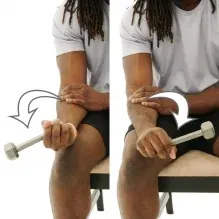
- Support your forearm on a table or your knee with your wrist in a neutral position.
- Using a weight like a can or water bottle, roll your wrist so that your palm faces downward.
- Hold for 2 seconds and return to the starting position.
- Increase the weight as tolerated.
- Repeat
- 10 times
- Hold
- 2 seconds
- Sets
- 3
- Per day
- 1 time
2
Exercise 2: Supination
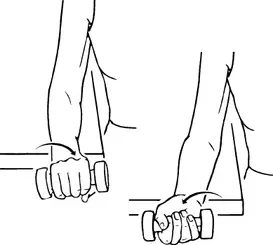
- Support your forearm on a table or your knee with your wrist in a neutral position.
- Using a weight like a can or water bottle, roll your wrist so that your palm is now facing upward.
- Hold for 2 seconds and return to the starting position.
- Increase the weight as tolerated.
- Repeat
- 10 times
- Hold
- 2 seconds
- Sets
- 3
- Per day
- 1 time
3
Exercise 3: Wrist Flexion
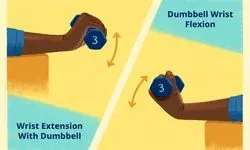
- To start, sit with your arm supported on a surface at 90 degrees, with your palm face up off the end of the table as pictured.
- Using a weight like a can or water bottle, hold it in your hand and curl your wrist up against gravity.
- Return to the start position and repeat.
- Increase the weight as tolerated.
- Repeat
- 10 times
- Sets
- 3
- Per day
- 2 times
4
Exercise 4: Wrist Extension
- To start, sit with your arm supported on a surface at 90 degrees, with your palm face down off the end of the table as pictured.
- Using a weight like a can or water bottle, hold it in your hand and extend your wrist up against gravity.
- Return to the start position and repeat.
- Increase the weight as tolerated.
- Repeat
- 10 times
- Sets
- 3
- Per day
- 2 times
5
Exercise 5: Ball Hook Grip
- Hold an elastic ball or any object that you can squeeze in one hand.
- Firmly squeeze it in the palm of your hand with a grip as shown.
- Hold for 1 second and repeat.

- Repeat
- 10 times
- Hold
- 1 second
- Sets
- 3
- Per day
- 2 times
What is it?
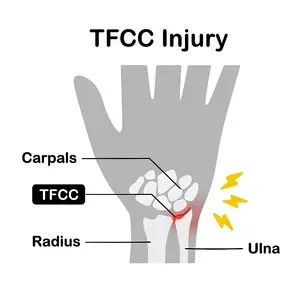
- The TFCC is a group of tissues on the pinky side of your wrist that acts like a cushion and helps keep the wrist stable.
- A tear happens when these tissues rip or get damaged.
- It can be caused by falling on your hand, twisting your wrist too hard, or normal wear and tear over time.
- Symptoms include pain on the pinky side, clicking or popping sounds, swelling, and trouble gripping.
- Doctors use exams or scans (like MRI) to check for a tear.
- Treatment can include rest, splints, medicine, therapy, or surgery if needed.